
Finding Charleston Resident Records
Charleston resident research works best when the question stays narrow. The Charleston County Auditor can connect an owner name or street to a parcel. The Charleston Register of Deeds can then confirm a recorded transfer. A Charleston court index can identify a case and its parties, while a Charleston County Public Library directory can place a household in a particular year. None of those tools is a complete list of people at an address. They are separate public trails, and the strongest result has a date, a record type, and a custodian behind it.
Begin with a name, address, old street name, case number, or directory year. Record the exact spelling and the Charleston result reference before moving to another source. A property owner may use a different tax-mailing address, a court party may share a name with someone else, and an old Charleston number may have changed. The Charleston County office, Charleston City Records Center, Charleston library, and state agency each provide a different access route when an online result is incomplete.
- Use the Charleston County Auditor or Parcel Viewer to turn a present address into a parcel or TMS number.
- Check the Charleston County Tax Site and the Register of Deeds for a matching owner, legal description, or book and page.
- Search the Charleston County Public Index only when a case, party role, or filing date can help distinguish a person.
- For a past household, select the exact Charleston CCPL city-directory year and compare its printed locality with the address history.
- Ask the record custodian for the counter, copy, appointment, or focused South Carolina FOIA route when the online index ends.
Note: A good Charleston record trail confirms one fact at a time instead of treating a search result as proof of current residence.
Charleston Resident Records Offices
The county’s core Charleston records offices divide the work. The Charleston Auditor maintains property cards and tax-billing addresses. The Charleston Register of Deeds keeps recorded instruments and the historic books behind them. The Charleston Clerk and Charleston Probate Court control different court files. State election tools are deliberately limited, while the Charleston City Records Center preserves municipal series and directs current City requests to its FOIA process. Use the office that created the record, then ask that custodian how to inspect or order the underlying item.
Charleston County Register of Deeds
101 Meeting Street
Charleston, SC 29401
843-958-4800
Charleston County Auditor
101 Meeting Street
Charleston, SC 29402-0614
843-958-4200
South Carolina Election Commission
Credentialed voter information
Statewide service for Charleston voters
Use the official voter tools
Charleston Auditor Search Fields
The Auditor Property Record Card search is a practical starting point for Charleston records when a name or property address is known. Its name form separates last, first, and middle names. Its address form uses a street number and street name, with no street type. A parcel search accepts a ten-digit TMS, or ten digits plus A or B, without punctuation. The result grid can show owner fields, the owner as of January 1, street number and name, and the parcel ID. It does not identify every person who lives there.
| Charleston field | Use | Format note |
|---|---|---|
| Last, first, middle name | Owner-name lead | No punctuation in name fields |
| Street number and name | Property-address lead | Omit the street type |
| Parcel ID / TMS | Parcel confirmation | Ten digits, with optional A or B |
| Sales date | Transfer-date route | Separate search mode |
Open the Charleston County Property Record Cards before using a parcel result as a bridge to the Charleston County Tax Site or Charleston deed index. The legacy portal says basic transfer data is complete back to 1991, and it directs current ownership history users to the County Tax Site.
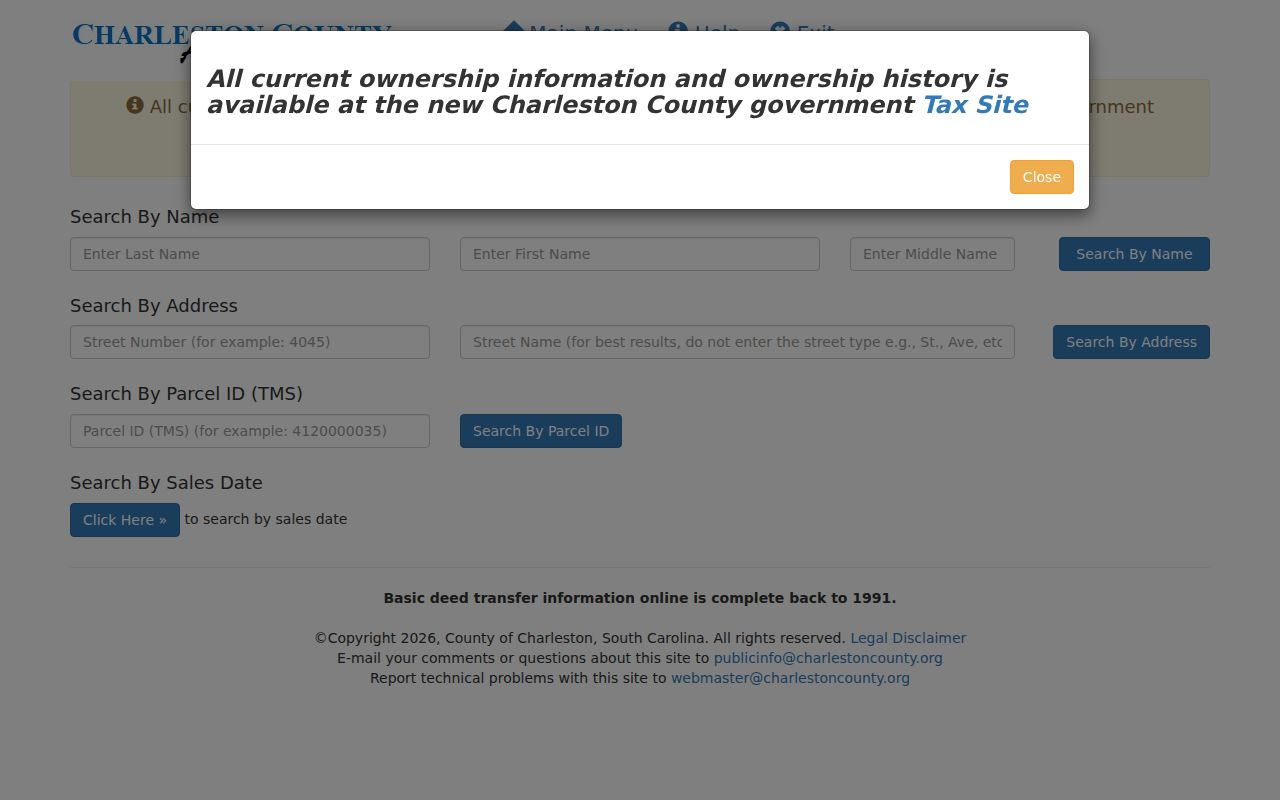
The image shows why a Charleston residents directory search should retain the search path, not just a name found in a result.
Charleston Parcel and City Records
For a map view, the Charleston County Parcel Viewer accepts parcel number, address, street name, or owner name. A selected parcel links to tax information and can be inspected against the adjoining boundaries. Its layers, labels, measurement tools, and mailing-label or buffer functions describe property geography, not household membership. That distinction matters when a Charleston resident search begins with an address.
Charleston City-held material is a separate lane. City GIS Document Search accepts an address, tax map number, ordinance number, street name, or plat query for City records. The Charleston City CSS route has permit, plan, inspection, and code-case filters. A permit contact or case entry marks an association with a project and date, not title or current occupancy. Verify that the address is within Charleston City jurisdiction before relying on a City result.
See the City Document Search interface below. Its City-only scope is an important limit for Charleston resident records across a place that reaches more than one county.
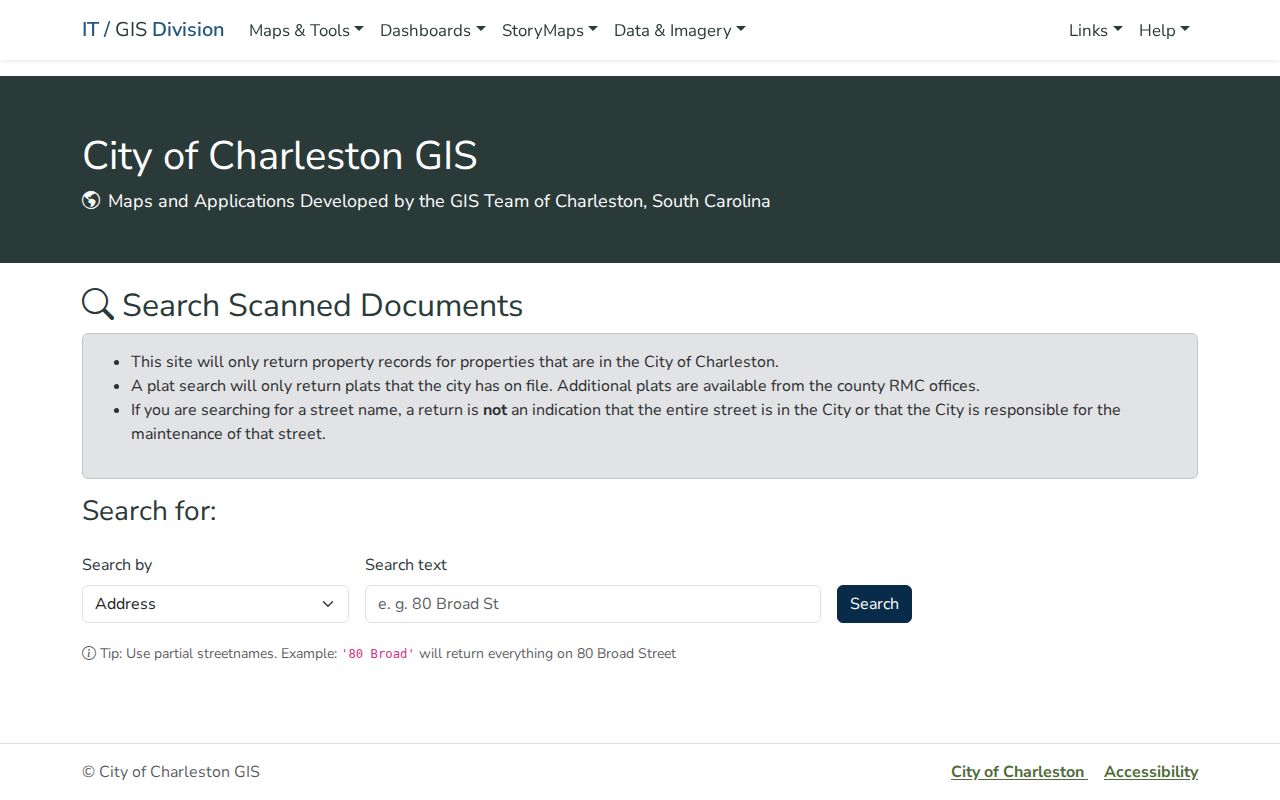
A parcel boundary, a City document result, and a deed each answer different parts of the same Charleston address question.
Charleston Deed Index Trail
The Charleston County Register of Deeds is where a property lead becomes a recorded-instrument trail. Its gateway includes name and date, type and date, book and page, tracer, plat, and index-book routes. The grantor is the person conveying an interest; the grantee is the recipient. Record the book and page or instrument reference, then inspect the image or obtain the custodian’s copy before treating a transfer as confirmed.
Online deed, mortgage, and tracer index data in the research coverage notice starts in 1978, while online deed, mortgage, and miscellaneous images start in October 1994. The ROD maintains physical access from 1719 to 1960 and film or microfiche access from 1960 to 2005. A no-result online can therefore be a date-limit issue, not proof that no Charleston record exists. The detailed address chain is available through the Charleston street directory.
- Parcel
- A numbered unit of land used in the county property system.
- Index
- A finding tool that points to a record, rather than the authoritative record itself.
- Criss-cross directory
- A reverse directory arranged by street and number instead of by name.
- Tracer
- An ROD path that can connect an original recording with related later documents.
Charleston Court and Voter Limits
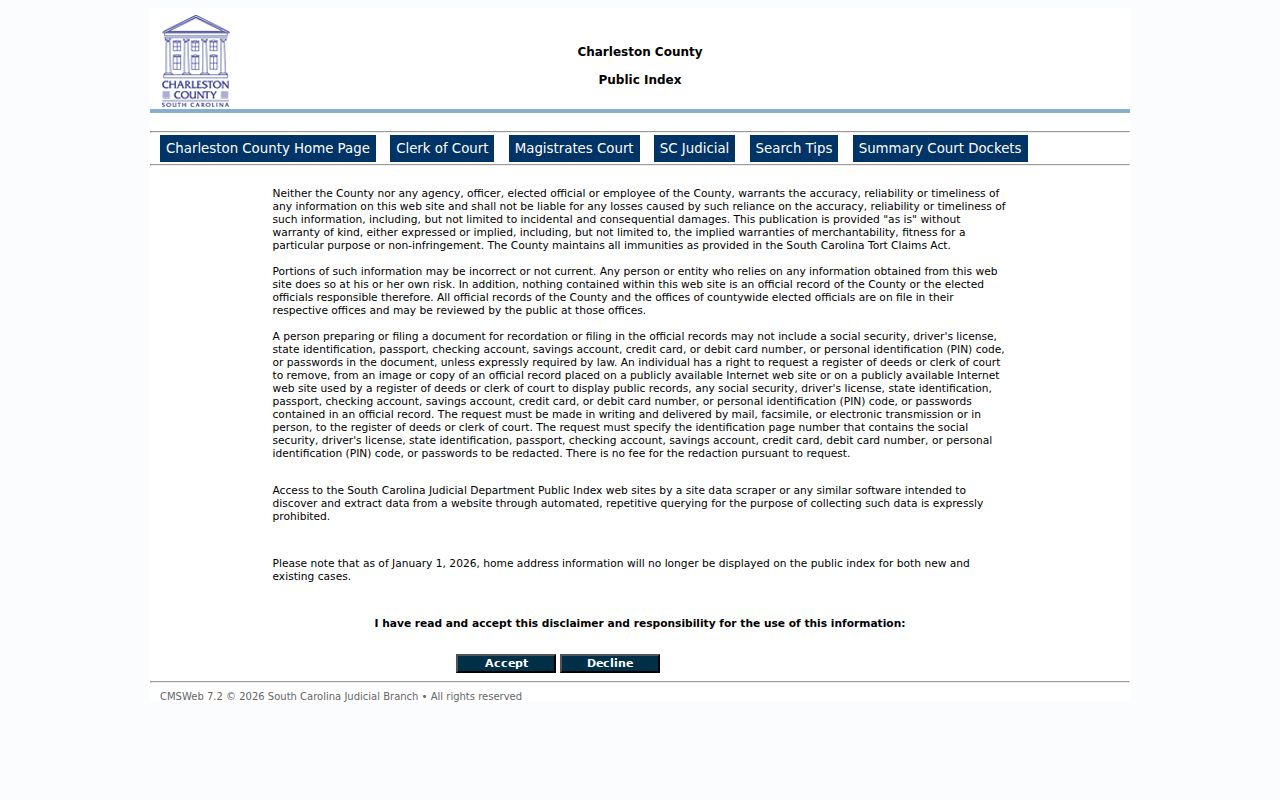
The Charleston County Public Index can help verify a party, case number, action, filing, and docket history when those facts fit a known Charleston person. Search results are a lead, not the official file. The Charleston court instructions call for name variations and date or action filters, and the clerk is the copy route. Home addresses stopped displaying in the Public Index on January 1, 2026. Sealed, confidential, juvenile, adoption, and expunged material is not a substitute address source.
Use the County Public Index only after a real case detail can help separate similar names. The screen below is an entry point for Charleston resident records, not a current-address list.
For voter information, MyscVOTES provides official tools, while its live registration login requires county, first name, last name, date of birth, and the last four digits of a Social Security number. It is self-service, not a public street roster.
The South Carolina voter tools show the official route and its limits for a Charleston resident inquiry.
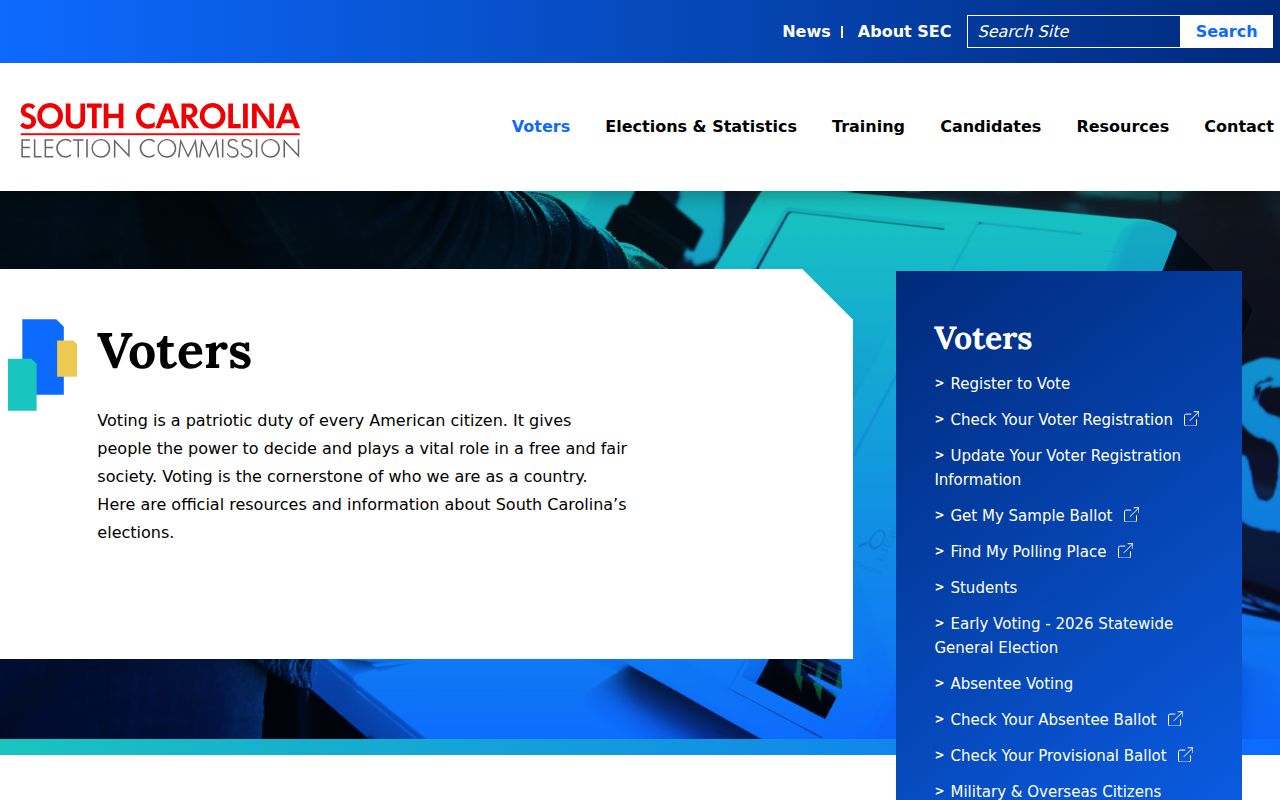
Registered South Carolina voters can request full voter lists under the state’s defined rules, but the general public cannot turn the credentialed tool into anonymous person or street search.
Current Charleston Resident Sources
There is no official all-purpose Charleston residents directory. Current official sources identify a limited relationship: an owner and parcel, a party and case, an estate participant, or a voter using credentialed self-service. The County Tax Site adds current property and sales context. Probate records can identify an estate’s representative or heir process. City CSS can identify a public project or case connected to a City address. Each source needs a second record or a custodian copy when the question is consequential.
| Source | Who It Lists | Keeper | Access |
|---|---|---|---|
| Property Record Card and Tax Site | Owners and parcel facts | County Auditor and Treasurer | Free online search |
| ROD document index | Parties to recorded instruments | Register of Deeds | Free index, counter for older material |
| County Public Index | Parties and court case facts | Clerk of Court | Online lead, clerk copy route |
| Probate estate search | Estate and marriage-file context | Charleston County Probate Court | Online landing page and court access |
| Credentialed voter tools | One voter’s self-service information | South Carolina Election Commission | Login and statutory list rules |
A historic directory entry, cemetery record, or newspaper notice belongs to a different Charleston directory layer. Those sources can corroborate a past household but do not establish a present address. A name-specific verification sequence should match a person across two independent custodians.
Charleston Vital and Estate Evidence
South Carolina Department of Public Health Vital Records certifies births, deaths, marriages, and divorces under record-specific rules. For Charleston events, the regional office is at the Teddie E. Pryor, Sr. Social Services Hub in North Charleston, while the state office is the mail custodian. Uncertified birth records become public after 100 years and death records after 50 years. Certified records have relationship or tangible-interest restrictions. Marriage certificates at DPH cover July 1950 through December 2023; Charleston County Probate handles earlier and later marriage licenses, and the Clerk supplies divorce decrees.
Open the DPH birth-certificate instructions for the official request, eligibility, fee, identification, and processing details. A vital record proves an event, not a universal Charleston resident roll. Probate records can add an estate relationship, but the court file and its copy procedure control what the record establishes.
The Charleston County Probate Court provides the local estate, will, guardianship, and marriage-license route. An estate result can be a useful historical connection when its case information is confirmed through Probate and the related recorded document.
Charleston Historical Directory Shelves
The Charleston County Public Library city-directory collection reaches from 1782 to the present, with some earlier 1735 material, but the books were not published every year. CCPL divides access among abstracts and microfiche, licensed HeritageQuest images, microfilm, and original books. Before 1890, most directories lack street indexes, except for the 1840–41 street cross index. Street or reverse listings appear from 1890 onward, and telephone numbers begin in 1936 editions. Check the exact volume’s printed locality because later editions include expanding Greater Charleston areas.
CCPL’s South Carolina Room is a research stop with current appointment and temporary-location details, not a general online shelf. The library also maintains maps, tax material, newspapers, City death returns, cemetery microfilm, and WPA or CWA transcriptions. The full collection runs and entry-reading method belong on the Charleston city directory page.
Visit the CCPL city-directory guide for the format-specific holdings visible in the image.
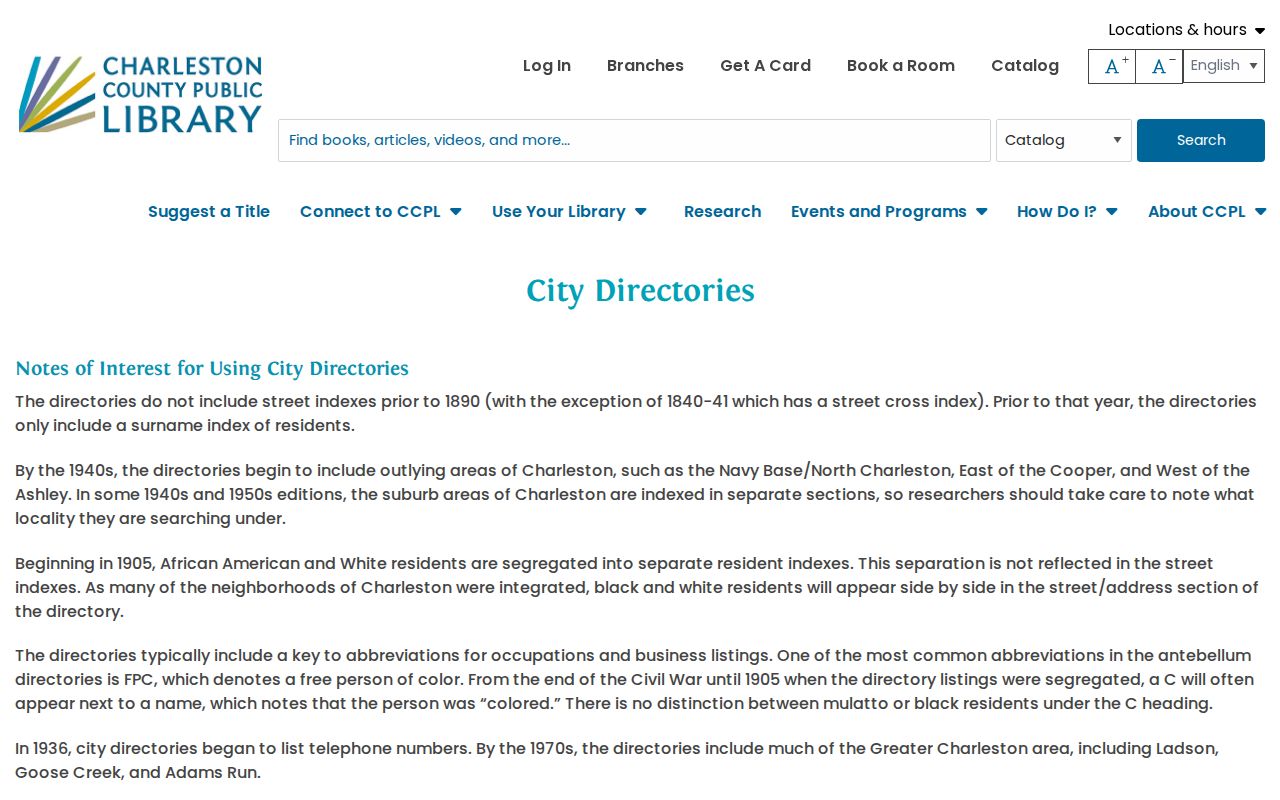
The selected year, local coverage, and index type are just as important as a matching name in a historical Charleston directory.
Charleston Address Changes Matter
Charleston’s record geography carries a useful warning for family and property research. Early street numbers began around 1780, later actions changed numbering in 1848 and 1850, and the 1884–86 system became the modern peninsular base. A 1901 proposal caused confusion, and 1983 emergency-address work corrected some irregularities. A current number should not be dropped into an old directory and treated as the same physical location without checking nearby names, ward order, maps, and the period’s street spelling.
The Charleston Archive street-number history documents the local method. Its image supports a numbers-first check before a Charleston residents directory result is tied to a historic house.
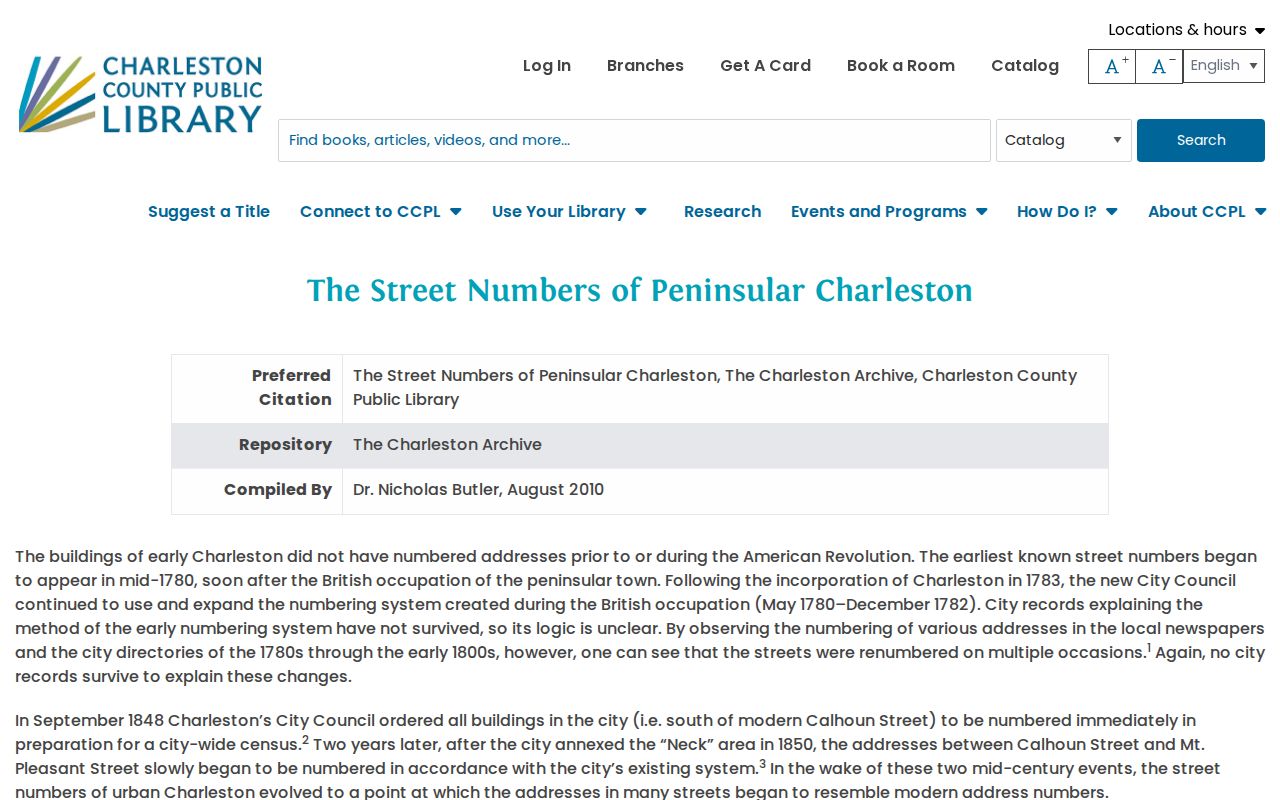
Adjacent listings over several years often provide a safer bridge across a Charleston renumbering than one number alone.
Historical Charleston Resident Directories
Historical Charleston resident directories record a household in a specific printed year. A name entry may include a residence, business or occupation context, spouse notation, and later a telephone number. A reverse section starts with the street and number, then lists an occupant. Neither form proves title or complete household membership. Record the volume date, locality, page or image citation, and any abbreviation key before comparing it with a deed, census, tax book, or estate file.
Charleston’s history includes both preservation and gaps. The ROD holds property books from 1719, while SCDAH holds conveyances from 1673 to 1719. CCPL holds published deed abstracts for 1719 to 1788 and many local supports. Municipal Council material has a documented 1783–1865 manuscript break, but newspapers from 1836 and an unbroken manuscript series beginning in October 1865 can be substitute sources. A missing web item or volume is a prompt to use the right archive, not a reason to invent a history.
Charleston Offline Records Routes
When a portal stops, Charleston has a specific fallback chain. The Charleston ROD’s physical books and film cover periods beyond the online dates. The Charleston City Records Center advises appointments for many historical municipal holdings and routes current requests through the City FOIA system. CCPL and the Charleston Archive hold historical directories, maps, microfilm, newspapers, and finding aids. The South Carolina Department of Archives and History has a research room, catalog, microfilm, copy equipment, staff help, and written research routes for records that have not been digitized.
The City of Charleston FOIA route separates City and Police Department request paths. A focused request should name the record group, time span, address, parcel, case, or file reference already found. South Carolina’s Freedom of Information Act, S.C. Code Ann. §§ 30-4-10 through 30-4-165, supplies the inspection and copy framework, but exemptions still apply.
A direct request to the named Charleston custodian is more useful than a broad demand for information about a person.
Note: Keep the portal result, date searched, and record reference with any Charleston request so staff can identify the correct file.
Charleston Resident Privacy Boundaries
Public access does not turn personal information into an open resident list. South Carolina’s Address Confidentiality Program gives eligible participants a designated address that state and local agencies and courts must accept. It does not erase information published before enrollment. The County Public Index excludes protected material and removed home addresses from display in 2026. Vital records have their own eligibility rules. Driver and vehicle address data are not a general directory route. Use Charleston records for lawful personal research, family history, estate questions, consumer safety, or civic context, never to monitor or harm someone.
Lawful use. Charleston resident records may help document a property, family, or historical question, but never use them to stalk, harass, intimidate, or harm a person.
A commercial people-search category can mix records from different dates and sources, create accuracy problems, and obscure the official custodian. Official property, court, library, and agency records are still the appropriate places to verify a specific fact. The County Parcel Viewer is a useful county source for a property question.
Open the Charleston County Parcel Viewer for its map-based record context.
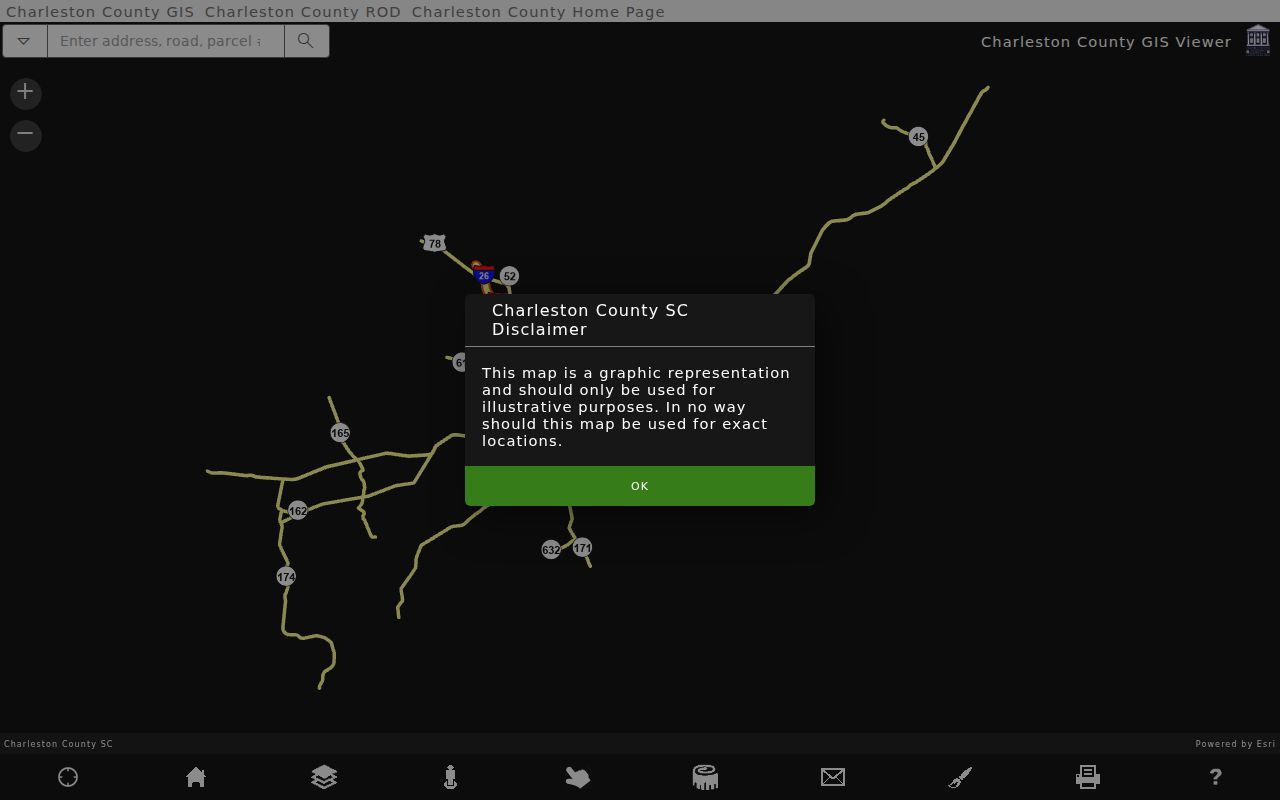
The Viewer shows parcel geography and tax links; it does not claim to show everyone who lives at a Charleston address.
Charleston Custodian Checks
Charleston County’s free Property Recording Alert System can send a courtesy email based on name-prefix matching. The ROD warns that the service can miss documents and create false positives because names vary. Preserve the alert, then verify the actual book, page, image, or counter record. It is a heads-up, not proof of ownership or wrongdoing.
The same care applies to time-sensitive custody information. The Sheriff announced a 2026 search delay to reduce jail-bail scams. Use the official Sheriff, court, or detention contact to confirm a real issue, and do not send money because of an unsolicited message. The Charleston County Inmate Search is a custody-status tool, not a Charleston residents directory.
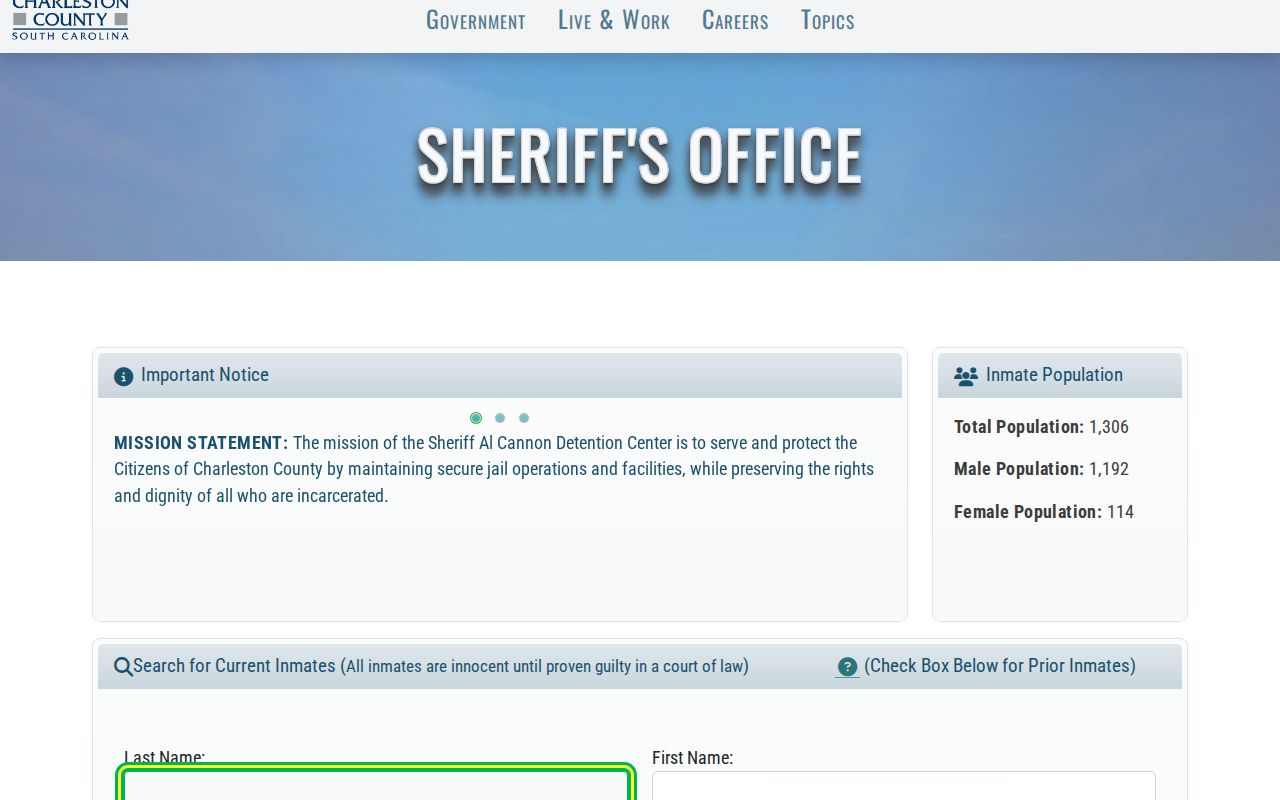
The official use notice and the announced delay are reasons to confirm any urgent claim with the responsible Charleston custodian.