
Charleston City Directory Holdings
The Charleston County Public Library city-directory guide identifies Charleston directories from 1782 to the present, although the series was not issued every year. It also identifies a 1735 abstract or volume. The useful feature is not a single run, but several Charleston formats with different access routes. Charleston early abstracts are held in book form or microfiche, the Charleston HeritageQuest route carries selected images through CCPL access, Charleston microfilm covers much of the later nineteenth and early twentieth centuries, and Charleston original books carry the later period. Select the year first, then use the Charleston format CCPL lists for that year.
| Collection | Years | Where Held | Access |
|---|---|---|---|
| Charleston abstracts and microfiche | 1735; named runs from 1782 to 1860 | CCPL South Carolina Room and Charleston Archive | On-site books or microfiche |
| Charleston HeritageQuest directory images | 1830, 1859, 1866 to 1867, 1869, 1872 to 1884, 1886 to 1925, 1927 to 1932, and 1934 | CCPL research database | Follow CCPL remote-access rules or ask staff for on-site help |
| Charleston directory microfilm | 1866 to 1932, with stated gaps | CCPL | Microfilm research route |
| Charleston original directory books | 1934 to present, except 1995 and 2002 | CCPL | Later printed volumes |
The library’s collection screen shows why year-by-year checking matters. Its Charleston coverage may include suburbs in separately indexed sections, especially in later editions. The printed Charleston locality and title page are part of the citation, not decoration.
Note: A missing annual volume records a publishing gap, not proof that a person or household disappeared from Charleston.
CCPL’s city-directory collection is the source for this Charleston city directory image and its documented format runs.
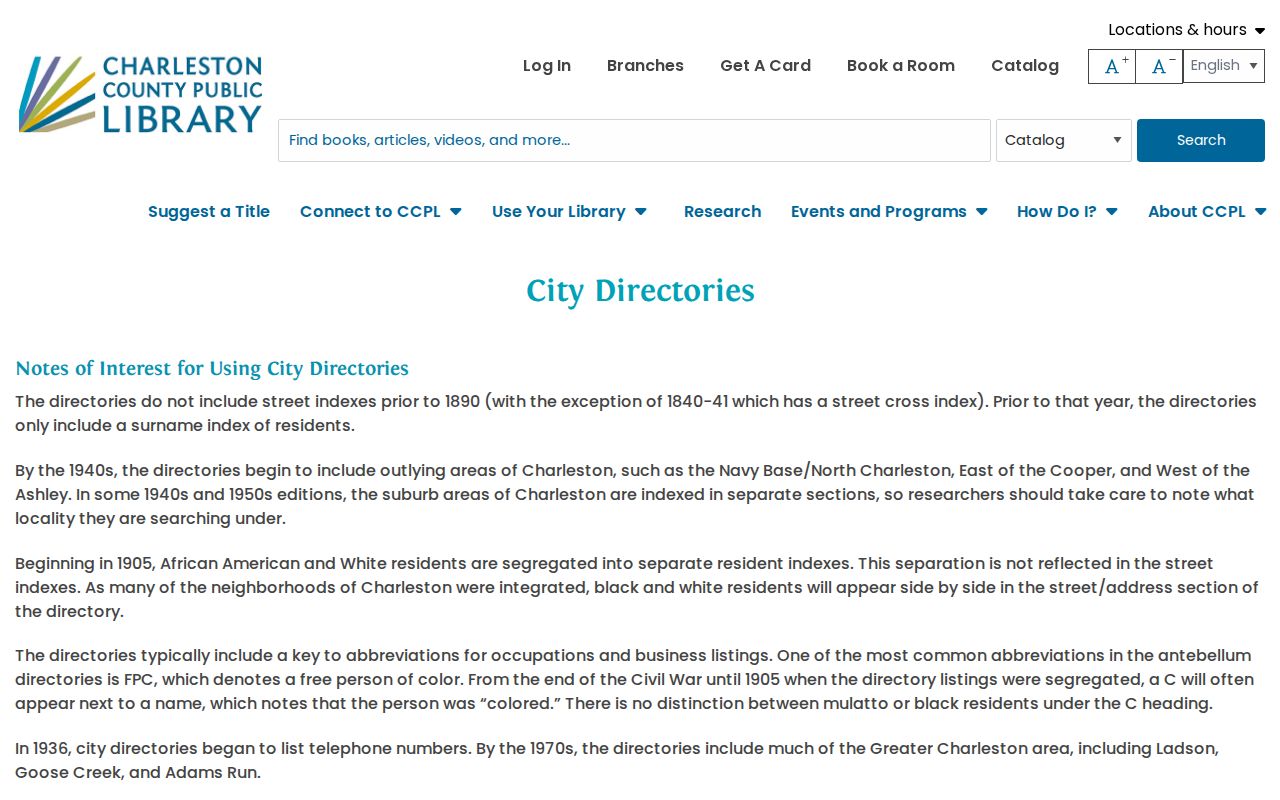
The collection route helps separate an online licensed database from a volume or reel that must be consulted through CCPL.
Charleston Directory Time Markers
Charleston city directories have landmarks that change the search method. In Charleston, the 1840 to 1841 volume has the exceptional street cross index, while directories before 1890 usually lack street indexes. Charleston street or reverse sections begin in 1890. Charleston telephone numbers begin in 1936. By the 1940s, some Charleston editions extend to places such as the Navy Base, North Charleston, East of the Cooper, and West of the Ashley. By the 1970s, coverage reaches much of Greater Charleston. A Charleston directory’s place name should therefore be read for that edition, not projected onto today’s city boundary.
CCPL also identifies Charleston R. L. Polk publication gaps in 1949, 1952, 1954, 1956, 1957, and 1962 through 1967. A Charleston searcher should test the editions immediately before and after a gap, then use a census, tax record, newspaper, or probate source to bridge the interval. This Charleston numbers problem has a long span, but its coverage is not one uninterrupted annual sequence.
| 1735 and 1782 | CCPL’s earliest listed Charleston material and start of its regular directory era. |
|---|---|
| 1840 to 1841 | Special street cross index, useful for an address-in search. |
| 1890 onward | Street or reverse-directory sections become available. |
| 1936 | Telephone numbers begin appearing in directories. |
Decoding Charleston Directory Entries
A Charleston city directory entry should be copied exactly before it is interpreted. CCPL says the books list residents and businesses and, over time, may show a residence, business notation, spouse information, historic race notation, and later telephone details. Each Charleston volume’s abbreviation key controls the meaning of its letters and initials. Charleston historic race notation belongs to the source’s period context and should not be treated as a current identity label. A Charleston entry is a finding aid, not a deed, title record, or complete household roster.
| Printed name | Copy the surname, initials, and any spelling variant exactly as printed. |
|---|---|
| Residence | Record the address only where that edition supplies it, along with the volume year and page or image citation. |
| Business notation | Preserve the business or occupation phrase and consult the book’s abbreviation key. |
| Family notation | Copy spouse or widow notation when used by that volume. |
| Later details | Telephone information can appear in editions beginning in 1936. |
| Street section | Where available, copy street name, house number, listed occupant, and adjoining entries. |
- Criss-cross directory
- The address-in or street-order part of a directory, where available, used to locate a number and its listed occupant.
- Resident index
- The name-in portion of a volume. It can lead to an entry but does not establish title or full household membership.
- Abbreviation key
- The volume’s explanation of its own short forms. Consult it rather than assigning a modern meaning to a letter.
Charleston Directories by Street
The Charleston street section is the strongest route when an old address comes first. CCPL directs researchers to the 1840 to 1841 cross index and to reverse listings from 1890 onward. Start with the Charleston street spelling used in that book, record the number and listed occupant, then copy names at nearby numbers. Those adjacent names can be more reliable than a single number when a lot was divided, a street was renamed, or an old number does not match a current one.
The published Charleston 1861 Frederick Ford census is arranged alphabetically by street and sequentially by house number. It is useful evidence for that address era, but CCPL cautions that Ford’s numbering system was not officially adopted by the City. Check it against Charleston directory neighbours, ward or tax material, and later official numbering before treating a number as the same physical building.
Charleston Archive’s street-number history documents the address changes that affect this Charleston city directory work.
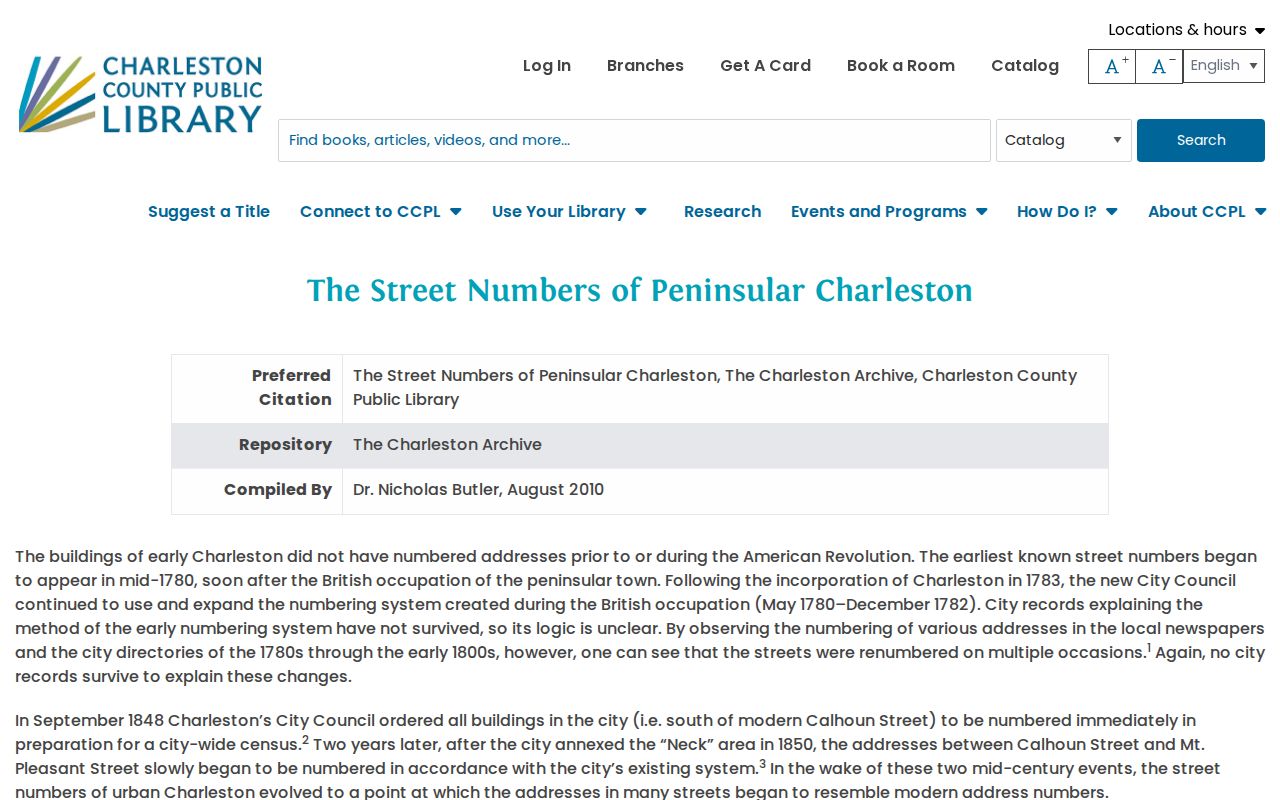
Use the numbering chronology before deciding that an apparent address change means a family moved.
Charleston Directory Indexing Context
Beginning in 1905, the resident indexes in some Charleston volumes separated Black and white residents, although the street sections did not. The library also notes period abbreviations in older material. Search both a surname and a street where possible, and compare nearby names instead of relying only on a single alphabetical index. This approach respects the original cataloging practice without carrying its historic labels into current description.
A separate historical route is CCPL’s municipal voter material. The archive holds voter ledgers for 1877 to 1879, and the 1877 index identifies 7,189 names. These are date-specific archival sources, not a current voter list. They can support a directory lead when the year and address context line up, but they should be cited as their own record set.
Note: Compare spelling, street form, and adjacent listings before treating a name-index miss as evidence that no entry exists.
Charleston Directory Household Trail
A Charleston household trail works best as a sequence of dated observations. Begin with the latest known name or address, select the exact CCPL volume, and copy the printed locality as well as the entry. For a Charleston address question, move into the special 1840 to 1841 material or a later reverse section. Before calling a changed number a move, test the address against Charleston’s numbering history. The collection’s documented format and access route should be saved with each volume citation.
- Transcribe the entry, volume title, year, address, and nearby listed names.
- Use a reverse section when it exists, then compare the target number with adjacent occupants.
- Pair the directory year with an available federal census year. From 1880 forward, CCPL’s guide says schedules can include street address, but census images are not indexed by street.
- Use ward or area information to find the correct census page, then read the vertically written street and number with the named household.
- For an ownership question, take the supported address, lot, or TMS to the Auditor and Register of Deeds rather than treating a directory as title evidence.
The directory fills years between census snapshots; the census gives a household view for its own date. A person who vanishes may have moved, died, gone unlisted, or appeared under a variant spelling. Death returns, cemetery material, newspapers, and Probate files can help test those possibilities without turning one omission into a conclusion.
Charleston Directory Map Clues
Charleston maps and property aids can answer questions that a printed Charleston city directory cannot. CCPL identifies Sanborn Fire Insurance Map years of 1884, 1888, 1902, 1929, 1944, 1951, and 1955 on microfilm, with street numbers, lot dimensions, building placement and use, materials, and an index. Its historic-property guide also identifies the McCrady Plat Collection, approximately 1680 to 1929, and lists deed abstracts, tax materials, and WPA or CWA transcriptions as additional archive routes.
CCPL’s digitized Sanborn Maps access page shows the library route for Charleston city directory researchers who need to test a number against a building and lot.
A Sanborn sheet can align a directory address with a lot and building form, but it does not name every person who lived there.
CCPL’s historic-property research guide brings the supporting Charleston city directory, map, deed, tax, and probate resources together.
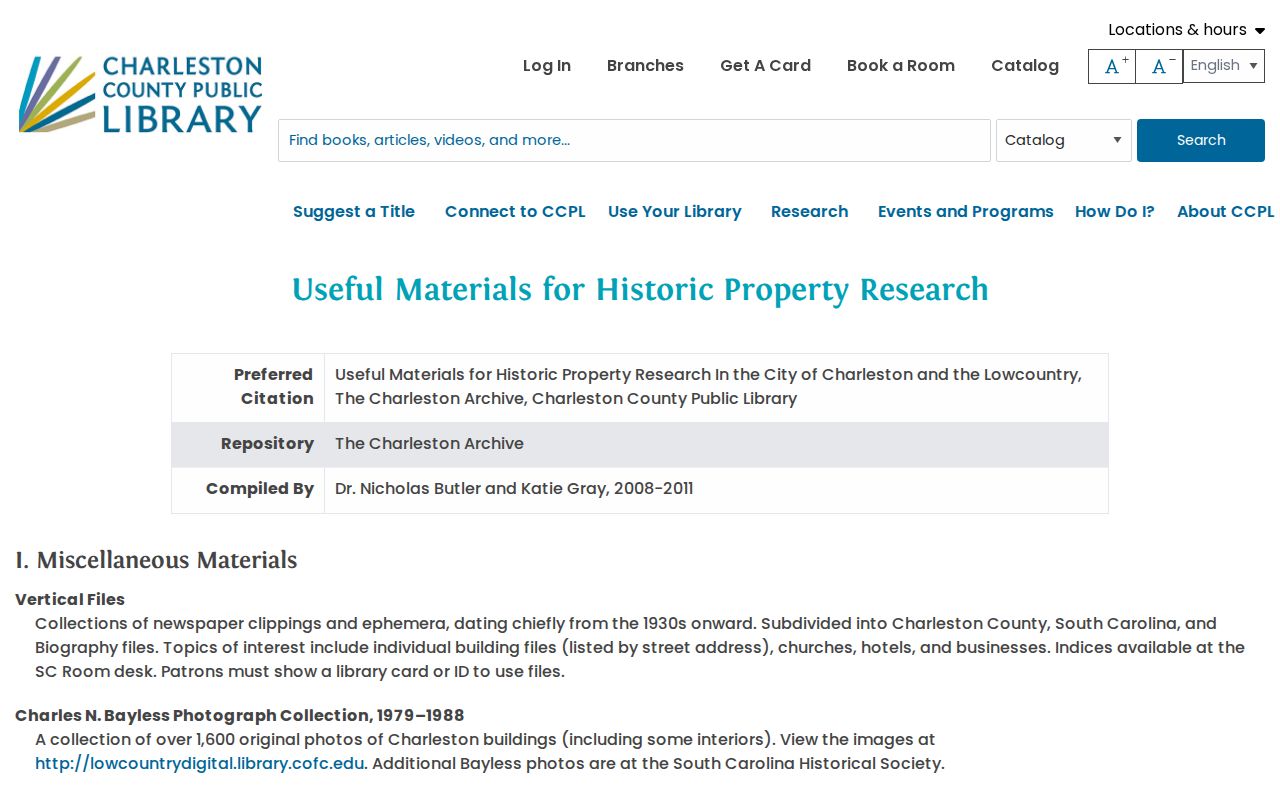
Those supporting sources are most useful after a dated directory entry has supplied a name, address, ward, or nearby property clue.
Charleston Directory Room Access
Not every Charleston directory source is available by a simple web search. HeritageQuest follows CCPL research-database access rules, and Ancestry Library Edition is inside-library-only. The South Carolina Room is also operating under a 2026 transition: CCPL announced a Main Library closure and temporary relocation, with the temporary location opening September 8, 2026 and research access by appointment. Confirm the current route with CCPL before making a trip for a directory, microfilm, map, newspaper, cemetery, or archive item.
When CCPL does not hold the needed archival series in a usable form, the South Carolina Department of Archives and History Research Room offers an online records index, catalog, microfilm, copy equipment, and staff assistance. The South Carolina Historical Society Archives is another Charleston repository for catalog and finding-aid research, with separate reading-room rules.
The South Carolina Historical Society Archives provides a distinct repository route alongside CCPL for Charleston city directory and related local-history research.
Separate repositories have separate catalogs and access rules, so save the collection name and date range before requesting help.